State of Nature—Dialogues
An Interdisciplinary Conference co-convened by Ravi Agarwal & Ranjit Hoskote and produced by Goethe-Institut / Max Mueller Bhavan Mumbai
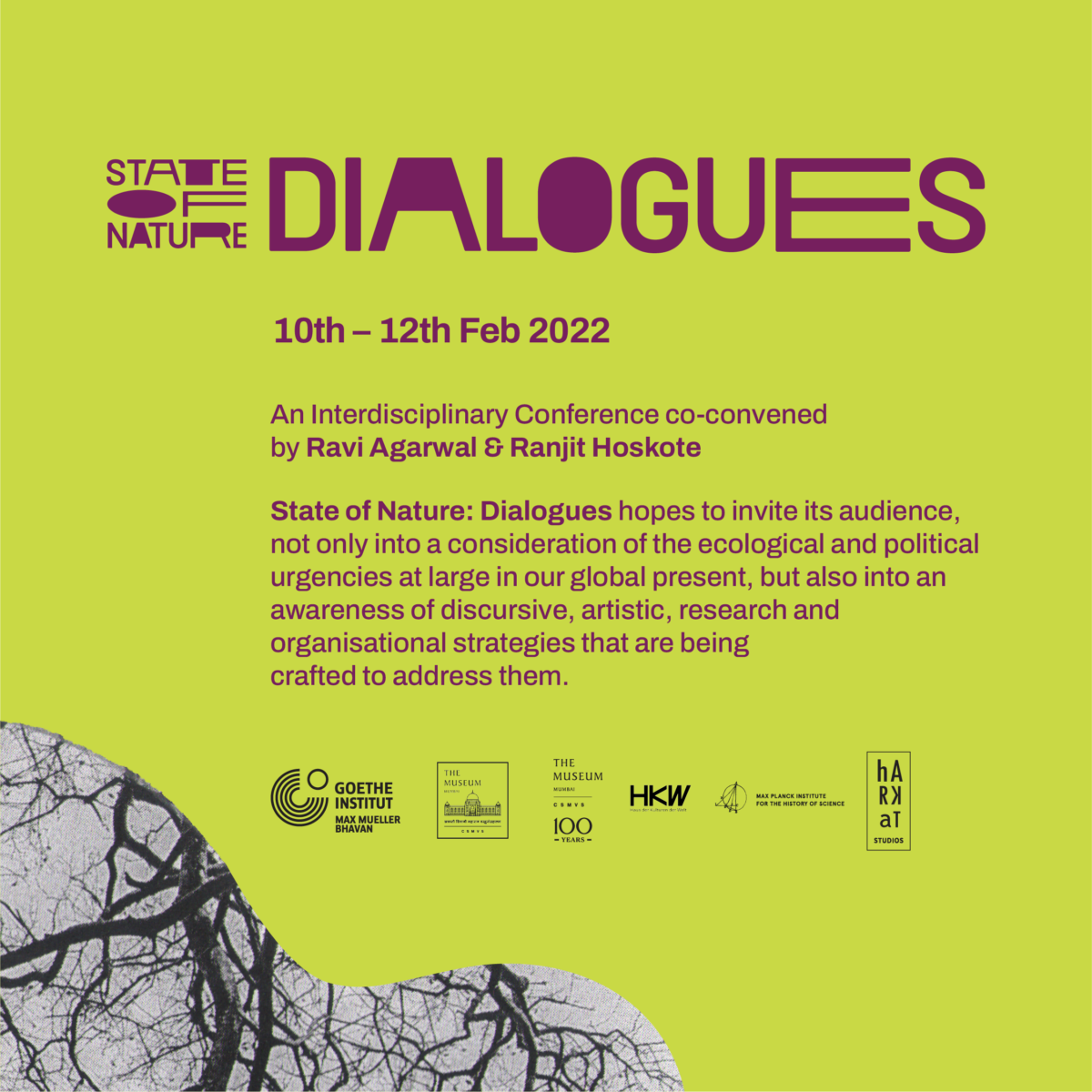
The aim of this three-day conference, organized by Goethe-Institut / Max Mueller Bhavan Mumbai, is to bring together a diversity of voices from across disciplines such as poetry, architecture, philosophy, anthropology, linguistics, activism, and art-making. By generating a constellation of perspectives and frameworks representative of the most current, contemporary thought in domains such as ecopoetics, habitat conservation, and social justice, State of Nature: Dialogues hopes to invite its audience, not only into a consideration of the ecological and political urgencies at large in our global present, but also into an awareness of the discursive, artistic, research, and organisational strategies that are being crafted to address them.
Among the themes that form the focal points of the conference are narratives concerning the interwoven questions of ecology, labour, livelihood, political and cultural representation, power and culture in a multi-species framework; vulnerable landscapes, at risk from human overreach; forms of cultural consciousness being evolved to engage with ecocide, urbanisation, and the marginalisation of communities and locales; architectural and planning reorientations to deal with the impact of runaway urbanisation and infrastructural expansion; and endangered occupations and livelihoods, under threat from anthropogenic interventions that generate alienation, asymmetry as well as social and environmental toxicity.
For more information and to attend please visit the State of Nature: Dialogues registration website.
Once registered, participants will receive log-in details on the morning of the conference—providing access to the live stream of the event.
- Thursday, Feb 10, 2022
2:30 pm - 8:45 pm
Day 1
2.30pm IST
Welcome address by Berthold Franke, RL Goethe-Institut SAS3pm IST
Introduction by Ravi Agarwal and Ranjit Hoskote3.15pm IST
Keynote by Michael Marder4.30pm IST
Panel 1: NarrativesStories told and repressed/yet to be told
This panel will reflect on forms of story and storytelling that convey experiences that have been repressed or disregarded, in turn embodying the overridden and overwritten claims of vulnerable groups and species to their lived environments; at the core of our deliberations are the closely interwoven questions of ecology, labour, livelihood, political and cultural representation, power and culture in a multi-species framework.
Chair: Latika Gupta
Thom van Dooren
Amitangshu Acharya
Anvita Abbi6.45pm IST
Panel 2: HabitatsVulnerable landscapes
This panel will reflect on vulnerable landscapes, together with the closely interwoven questions of ecology, labour, livelihood, and culture.
Chair: Pankaj Sekhsaria
Rahul Ranjan
Arunkumar HG
Heather Davis - Friday, Feb 11, 2022
4:00 pm - 10:00 pm
Day 2
4pm IST
Keynote 2 by Ruth Padel5.15pm IST
Panel 3: TransformationsForms of consciousness
This panel will reflect on artistic responses to the climate catastrophe and on the forms of cultural consciousness that we must develop to engage with the effects of ecocide, urbanisation, the oppression of vulnerable groups and landscapes—with implications for the vexed, interwoven questions of habitat, labour, livelihood, and culture.
Chair: Vinita Agrawal
Achia Anzi
Nancy Adajania
Bhrigupati Singh7.30pm IST
Panel 4: CommunitiesReorienting group relationships with place and change
This panel will reflect on how groups and communities re-orient their relationships with place and change, in the midst of the epic upheavals of ecocide, runaway urbanisation, the infrastructural monopolisation of vulnerable landscapes—with implications for architectural practice, as well as the vexed and interwoven questions of habitat, labour, livelihood, and culture.
Chair: Mustansir Dalvi
Anupama Kundoo
Prem Chandavarkar
Ratish Nanda
Parag Tandel - Saturday, Feb 12, 2022
4:00 pm - 9:30 pm
Day 3
4pm IST
Keynote 3 by T.J. Demos5.15pm IST
Panel 5: LivelihoodsEndangered/shifting occupations
This panel will reflect on endangered and shifting occupations, at risk from large-scale anthropogenic interventions, whether infrastructure, urbanisation, or the amplification of caste and ethnic differences in a contemporary grid of asymmetries.
Chair: Vishwajyoti Ghosh
Mukul Sharma
Rajyashree Goody
Kanchi Kohli7.30pm IST
Panel 6: Conclusions and DeparturesChair: Amruta Nemivant
Ravi Agarwal
Ranjit Hoskote