29°57’50.26″ N 90°44’01.94″
The mining compound at Deqingcun, 120 km northwest of the Tibetan capital Lhasa, acts as a surrogate for the Chinese‒Tibetan conflict. Eva Castringius makes the exploited landscape visible by using it as a pattern for a hand-knotted rug.
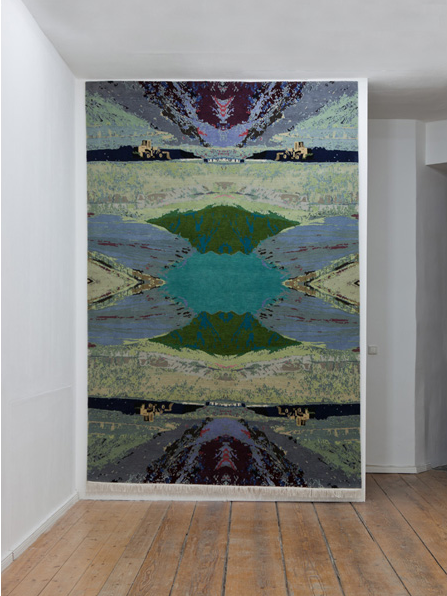
The work 29°57’50.26″ N 90°44’01.94″ is related to my experiences during my stay in Tibet in the winter of 2013. The focal point of this work is the large-sized rug, which I had made according to traditional Tibetan techniques of knotting. As a reference for the rug I took photographs of a specific mining landscape, where minerals such as gold and iron are extracted and processed. The chemicals used in these processes extensively contaminate the soil and the groundwater of the region. I discovered this facility that appears to be carved into the mountainous surroundings adjacent to the National Road 109 connecting Lhasa to Beijing in the vicinity of the village of Deqingcun, 120 km northwest of the Tibetan capital. In close proximity to this mining compound, I drew attention to the already straightened river, Duilong Qu, on which Deqingcun is situated. The “technical marvel” of the Lhasa railway as a further direct connection between Beijing and Lhasa creates an infrastructural basis for the extraction of resources in this region. This extensive structure of interventions and their interactions form my reflections of this work. I draw attention to the complexity of Tibetan culture and the dangers it faces. This mining compound at Deqingcun acts as a surrogate for the Chinese–Tibetan conflict, which is highly motivated by the geopolitical interests of the Chinese government. The Tibetan traditional hand-knotted rugs are a vital Tibetan craft whose preservation could be seen as a symbol of resistance against the methodical destruction of the Tibetan culture. From the historical point of view, Tibet’s oppression is coded in the knotting process of my rug artwork 29°57’50.26″ N 90°44’01.94, which I commissioned to be produced in one of the first Tibetan refugee camps in Kathmandu in Nepal. My design refers to the photographs of the specific mining operation (mentioned above) and was knotted in a two-year collaboration with the rug-makers of the camp.
The installation was part of the exhibition “Restricted Area” and was shown in the gallery Jens Walther in Berlin in 2015. The photography was presented at “Rohkunstbau XX. Revolution” (Roskow Castle, Brandenburg) in 2014. The international group show was curated by Mark Gisbourne and Ulrike Grelck.